


12 oz bag of whole bean coffee
Process: Natural
chocolate, red wine, gummy bears
With an enticing aroma of cheesecake, this Costa Rica Finca La Guaca has notes of red wine and gummy bears, you’ll have to taste it to believe it.
Coffee came to Costa Rica as early as 1779 and within 50 years was generating more revenue than any other crop, but by the 1830’s they were growing more coffee than the ships heading south could take. And virtually no infrastructure existed for transporting even a small amount of green coffee to the east coast of Costa Rica (where London was a mere 5,000 miles away). The distribution woes of Costa Rican coffee producers reached the ears of an up-and-coming shipping magnate named William Le Lacheur in 1841 and on Christmas day, 1841 he sailed The Monarch into port at Puntarenas, Costa Rica, and thus began a long and mutually beneficial relationship. On one voyage to London in late in 1843, the Monarch carried more than half a million pounds of Costa Rican coffee.
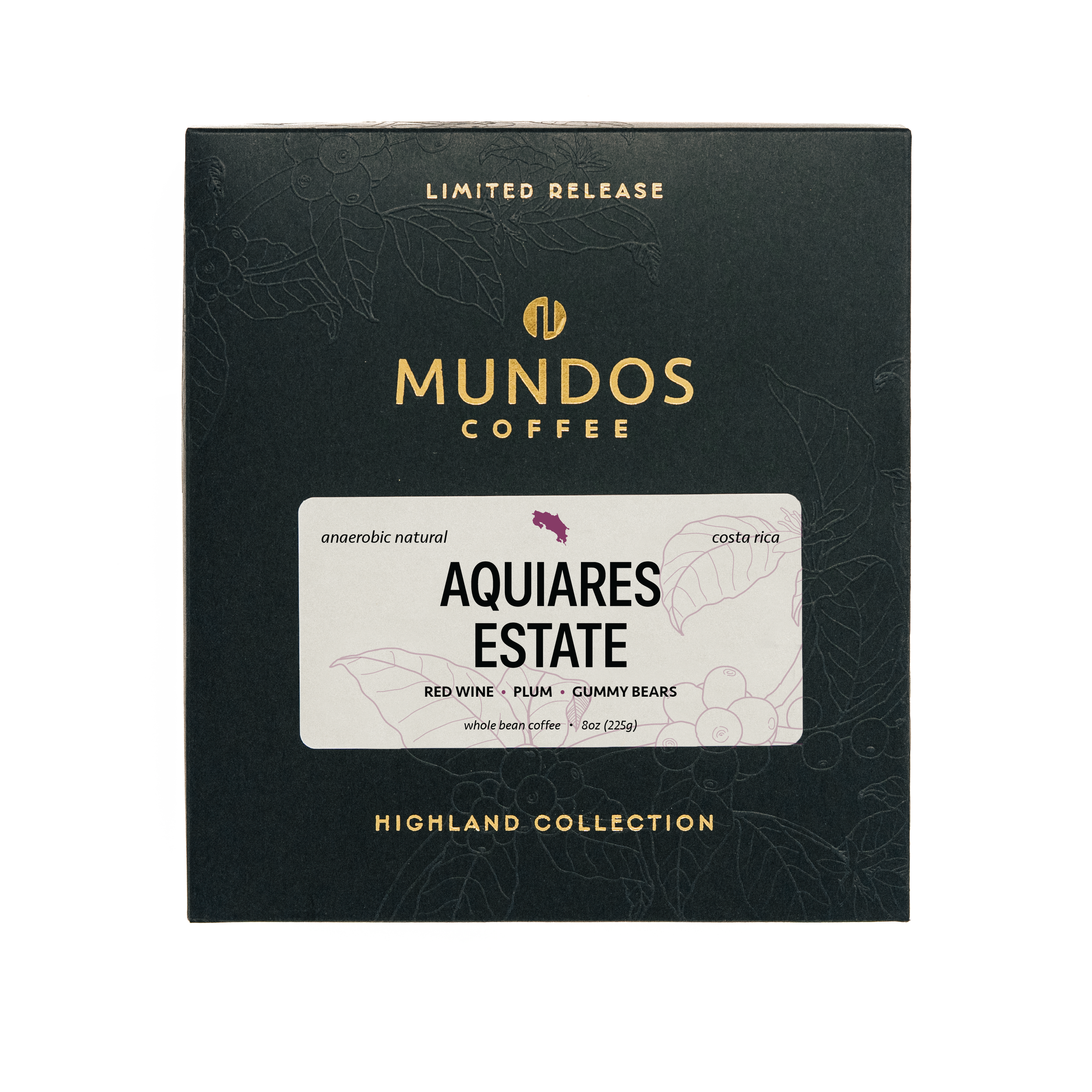
HIGHLAND COLLECTION
Whole Bean Coffee
[KOH-STUH • REE-KUH • AH-KEE-AR-ES • ES-TATE]
Process: Anaerobic Natural
Red Wine, Plum, Gummy Bears
Notes of red wine and a syrupy body, this anaerobic process coffee has a beautiful plum finish.
The name Aquiares means “land between rivers” in the Huetar indigenous language, and Aquiares Estate is commonly referred to as “Aquiares Coffee and Community.” It is the largest farm in Costa Rica and home to 1,800 people. Although the farm was founded in 1890, Alfonso Robelo is the man responsible for its transformation a century later. Alfonso arrived in Costa Rica in the 1980’s seeking refuge from the civil war in Nicaragua, where he was politically active. When politics soured into violence, he fled the country to keep his family and himself safe after receiving several threats against his life. Once in Costa Rica, Alfonso began building the Aquiares community on the enchanting slopes of the Turrialba volcano, a lush area of forests, rivers, fauna, and bright flora.
Alfonso challenged the status quo, transforming the relationship between landowner and farm workers. He brought a visionary approach to Aquiares, a farm suffering from low prices and instability. Aquiares had more than 200 employee homes on the farm, but because none owned their home, there was great insecurity in the workforce. Alfonso saw this as an opportunity to strengthen the company by having people feel pride in the coffee they produce. He evolved the farm into a small town where workers purchased their own homes. Today, Aquiares remains a model of sustainable agriculture.
Nowadays Alfonso’s son, Diego, manages the farm. Under his lead, the farm has taken a fresh approach to specialty coffee and exploring the farm’s potential. Through excellent agricultural management, embracing new varieties, and experimenting with processing, Aquiares has become a trailblazer among specialty coffee producers in Costa Rica and all of Central America.
This lot of Mariana coffee underwent anaerobic natural processing. The cherries are floated and washed with fresh water but not depulped. Afterwards, the coffee cherries are placed in a stainless-steel tank with a one-way air valve. In the tank, the coffee starts to ferment with the natural microorganisms and yeast present on the coffee cherries. The fermentation pushes out all the oxygen, and after one or two hours, an anaerobic environment is created within the tank. This fermentation continues for a total time of 24 hours. After fermenting, the cherries are washed again with fresh water and dried in the solar dryer. For two days, they are first placed on a ceramic patio and then finish drying on layered beds within the solar dryer.

Whole Bean Coffee
[KOH-STUH • REE-KUH • UH-KWEE-AR-ES • PEE-BEHR-EE]
Process: Washed
Brown Sugar, Cherry, Lime
Juicy sweet peaberry, with a sugary sweetness and lime aftertaste.
The Aquiares Estate Farm was founded in 1890, but it became the operation it is today in the 1980’s by Alfonso Robelo. Alfonso arrived in Costa Rica as a refugee from Nicaragua and transformed the land into a community built up around coffee.
Alfonso challenged the status quo, transforming the relationship between landowner and farm workers. He brought a visionary approach to Aquiares, a farm suffering from prices and instability. Aquiares had more than 200 employee homes on the farm, but because none owned their home, there was great insecurity in the workforce. Alfonso saw this as an opportunity to strengthen the company by having people feel pride in the coffee they produce. He evolved the farm into a small town where workers purchased their own homes. Today, Aquiares remains a model of sustainable agriculture.
The name Aquiares means “land between rivers” in the Huetar indigenous language, and Aquiares Estate is commonly referred to as “Aquiares Coffee and Community.” It is the largest farm in Costa Rica and home to 1,800 people. Although the farm was founded in 1890, Alfonso Robelo is the man responsible for its transformation a century later. Alfonso arrived in Costa Rica in the 1980’s seeking refuge from the civil war in Nicaragua, where he was politically active. When politics soured into violence, he fled the country to keep his family and himself safe after receiving several threats against his life. Once in Costa Rica, Alfonso began building the Aquiares community on the enchanting slopes of the Turrialba volcano, a lush area of forests, rivers, fauna, and bright flora.
Alfonso challenged the status quo, transforming the relationship between landowner and farm workers. He brought a visionary approach to Aquiares, a farm suffering from low prices and instability. Aquiares had more than 200 employee homes on the farm, but because none owned their home, there was great insecurity in the workforce. Alfonso saw this as an opportunity to strengthen the company by having people feel pride in the coffee they produce. He evolved the farm into a small town where workers purchased their own homes. Today, Aquiares remains a model of sustainable agriculture.
Nowadays Alfonso’s son, Diego, manages the farm. Under his lead, the farm has taken a fresh approach to specialty coffee and exploring the farm’s potential. Through excellent agricultural management, embracing new varieties, and experimenting with processing, Aquiares has become a trailblazer among specialty coffee producers in Costa Rica and all of Central America.
Peaberry coffee is named for its pea-like appearance. Most coffee cherries contain two seeds, and Peaberries occur when only one seed, small and round in shape, develops in the cherry. Grand Peaberry coffee from Aquiares is named for its relatively large bean size compared to typical Peaberries. This lot was mechanically washed and dried on raised beds in a solar dryer for 18 to 24 days.
Whole Bean Coffee
[KOH-STUH • REE-KUH • UH-KWEE-AR-ES]
Process: Red Honey
Raw Sugar, Lemon Custard, Caramel
The Aquiares Estate Farm was founded in 1890, but it became the operation it is today in the 1980’s by Alfonso Robelo. Alfonso arrived in Costa Rica as a refugee from Nicaragua and transformed the land into a community built up around coffee.
A clean, bright, and pleasant cup with a sweet finish, offering notes reminiscent of lemon custard and caramel.
Alfonso challenged the status quo, transforming the relationship between landowner and farm workers. He brought a visionary approach to Aquiares, a farm suffering from prices and instability. Aquiares had more than 200 employee homes on the farm, but because none owned their home, there was great insecurity in the workforce. Alfonso saw this as an opportunity to strengthen the company by having people feel pride in the coffee they produce. He evolved the farm into a small town where workers purchased their own homes. Today, Aquiares remains a model of sustainable agriculture.
Grown and processed on the Aquiares Estate, this farm is the largest in Costa Rica. With a focus on carbon neutrality, wildlife, and equity the Aquiares Estate is an innovator in specialty coffee.
Centroamericano H1 is an F1 hybrid variety generated by crossing the Sarchimor T-5296 and a wild Rume Sudan variety. It is reproduced through a tissue culture cloning process called somatic embryogenesis. This cultivar has been distributed among coffee producers in Central America over the last decade and the first productive harvests are now available. Turrialba’s climate is well suited to growing this new variety, and Aquaires is up to the challenge of meeting its complex nutritional needs. This hybrid represents the best of the farm and cupping worlds because it is high-yielding and rust-resistant, and also has a complex, elegant profile.
Honey processing removes the coffee pulp or cherry skin but leaves the sweet mucilage intact on the coffee bean during the drying stage. The descriptor “red” refers to the color of the mucilage as it dries on the coffee beans. This is later hulled off with the parchment during milling, but the sugars have been absorbed into the coffee bean giving greater dimension to the final cup. Red Honey from Aquiares is dried on raised beds for 18–24 days.