

The Basics of Coffee Processing
Why do many coffees have a wild difference in flavor? Coffee varietals, growing methods, climate, elevation, soil, harvesting techniques, roasting style and brewing methods all affect the flavor of coffee. However, one of the greatest variables that can impact the taste of a particular coffee is how it is treated immediately after harvest. We call this coffee processing. The two most common processes are washed and natural.
Natural processed coffees are dried and fermented while still inside the fruit of the coffee cherry. If this process is done correctly, the results can give us super flavorful coffee with muted acidity and incredible sweetness. Natural processed coffees many times have berry undertones and taste like different types of wine. Currently, we have several different natural processed coffees:

Whole Bean Coffee
[EETH-EE-OPE-YA • MISS-ISS • GEM-A-DECH]
Process: Natural
Cherry, Plum, Lavender
This natural process Ethiopia is a juicy sweet coffee with plum notes and a beautifully smooth finish that leaves a hint of lavender on your tongue.
Mrs. Gemedech Fulasa was born not too far from where she currently lives, and she is the only child to her parents. She inherited her 4.5 hectare coffee farm when her father passed away in 2011. In the Gedeo culture, land inheritance usually goes to the male children. However, her being the only child, she has taken this opportunity to inherit the land and shine as one of few female coffee farmers and one of the highest quality coffee farmers in Yirgacheffe. Before inheriting the coffee farm, she and her husband supported their family of four children through the Kocho trade. Kocho is a local staple source of carbohydrates that is made from a trunk of a false banana tree, called Enset – a crop that now allows both additional income and improved soil moisture.
Mrs Gemedech’s land in the famed Idedo region of Yirghacheffe (part of Ethiopia’s southern coffee growing region) is a garden farm where coffee is grown under a shade mixed with other fruits and food staples in a regenerative manner. Fallen leaves and coffee pulp hauled from local mills are the main source of compost. Enset trees (false Banana) across the farm collect water from the rainy season inside their trunks and release it to the ground during the dry season. This helps the soils retain moisture all year round.

12 oz bag of whole bean coffee
Process: Natural
chocolate, red wine, gummy bears
With an enticing aroma of cheesecake, this Costa Rica Finca La Guaca has notes of red wine and gummy bears, you’ll have to taste it to believe it.
Coffee came to Costa Rica as early as 1779 and within 50 years was generating more revenue than any other crop, but by the 1830’s they were growing more coffee than the ships heading south could take. And virtually no infrastructure existed for transporting even a small amount of green coffee to the east coast of Costa Rica (where London was a mere 5,000 miles away). The distribution woes of Costa Rican coffee producers reached the ears of an up-and-coming shipping magnate named William Le Lacheur in 1841 and on Christmas day, 1841 he sailed The Monarch into port at Puntarenas, Costa Rica, and thus began a long and mutually beneficial relationship. On one voyage to London in late in 1843, the Monarch carried more than half a million pounds of Costa Rican coffee.

12 oz bag of whole bean coffee
Process: Natural
blueberry, cacao, floral
Blueberries anyone? This Ayarza Natural from Guatemala is rich in blueberry and cacao notes, we love this coffee.
Laguna de Ayarza (Lake Ayarza) is a crater lake in the Santa Rosa department of Guatemala. It is known locally as Laguna Azul (Blue Lake). Lake Ayarza was formed by a volcanic eruption. The lake has a surface area of 14km² and is located at 1,400masl.

12 oz bag of whole bean coffee
Process: Natural
chocolate, cashew, toast
Denise Aparecida Pereira is a second-generation coffee producer, whose recently established 25-hectare farm is located in the Minas Gerais region.
American colonists had been drinking coffee for fifty years before the first coffee seed was planted in Brazil in 1727. A hundred years later, Brazil accounted for 30% of the world’s coffee supply. A hundred years after that, in the 1920’s, Brazil held a virtual monopoly, producing 80% of the world’s coffee. Although Brazil’s market share peaked at 80% in the 1920’s, its continuing status as the world’s largest coffee producer still gives the country considerable influence on the market and coffee prices. It is said that when Brazil sneezes, the coffee world catches cold. In 1975, a “black frost” destroyed over 70 percent of the crop in Brazil and coffee prices doubled world-wide. Brazil was a founding member of the Pan-American Coffee Bureau, which invented the concept of a “coffee break,” during an advertising campaign in the early 1950’s.
Natural processed coffees are fermented in many different ways. One of those methods is an anaerobic process where coffees are fermented in pressurized, sealed tanks without oxygen present. These anaerobic naturals take on unique and intense flavors. Currently, we have one anaerobic natural in our lineup. The Zambia Ngoli Estate tastes like blueberries and white chocolate and has an incredible sparkling pink lemonade finish. We think this coffee really showcases what is so special about this particular fermentation process:

12 oz bag of whole bean coffee
Process: Anaerobic Natural
blueberry, white chocolate, pink lemonade
The history of Zambian coffee seems familiar: men in Holy Orders of one sort or another arrive and plant seeds. But in the case of Zambia, missionaries did not introduce coffee farming until the 1950s. By the time commercial coffee production began in Zambia, the British had considerable experience in starting and operating coffee plantations in India, Kenya, and elsewhere. Planting coffee was an attempt to decrease a dependence on copper exports. Not surprisingly, the emphasis was on yield and production efficiencies. Plantations were large and orderly, grown in full sun on flat land, and processed in large wet mills wherever possible. Nevertheless Zambia made almost no appearance whatsoever on the world coffee stage until coffee was officially exported for the first time in 1985
The Northern province has the best conditions for arabica coffee cultivation in Zambia with its relative proximity to the equator and abundant altitude (Mafinga Hills being the highest point in the country at 2,300 masl). Most coffee grows from 1300 - 2300 masl. Zambia produces both washed and naturally processed coffee and has introduced some honey processing. A wide range of varieties including Catimor 129, Castillo, Java, and other trial varieties. Specialty grades are AAA, AA, AB and Peaberry.
Arriving soon is another anaerobic natural from Basha Bekele in Ethiopia, and it’s an outstanding coffee that we can not wait to share.
Most coffees we roast are fully washed, a more common process where the coffee cherry is completely removed from the coffee bean before it’s dried. We love washed coffees because they are usually brighter and cleaner with more defined levels of acidity. We have several washed coffees available:

12 oz bag of whole bean coffee
Process: Washed
marshmallow, apricot, floral
Pontien Ntunzwenimana is majority owner of the Migoti Washing Station in Mutambu, Burundi and was born and lived through his childhood in Mutambu. The multi-generational coffee farmers in Pontien’s home community had all but abandoned coffee as a source of income due to the 12-year civil war (1993-2005) when their Arabica coffee trees were neglected and destroyed. With peace in the country and a state-of-the-art coffee washing station that Pontien built in 2016, the local community has new-found hope for the future, and farmers are again investing in their coffee farms. Pontien’s six years of green coffee production in Mutambu (2016-2022) have proven the local coffee to be some of the best in Burundi. Migoti Coffee's vision is to see the local coffee-growing community grow in health and economic prosperity, with quality coffee production as one of several entrepreneurial activities underway.

12 oz bag of whole bean coffee
Process: Washed
papaya, nectarine, pineapple
The Nensebo Riripa from Ethiopia has delicious notes of papaya and nectarine and has a tea-like smooth mouthfeel.
This coffee is sourced from smallholders in Riripa village in West Arsi, Sidamo. Farmers cultivate coffee at 1,900 to 2,200 meters above sea level. They deliver their coffee to a local washing station owned and operated by SNAP Trading.
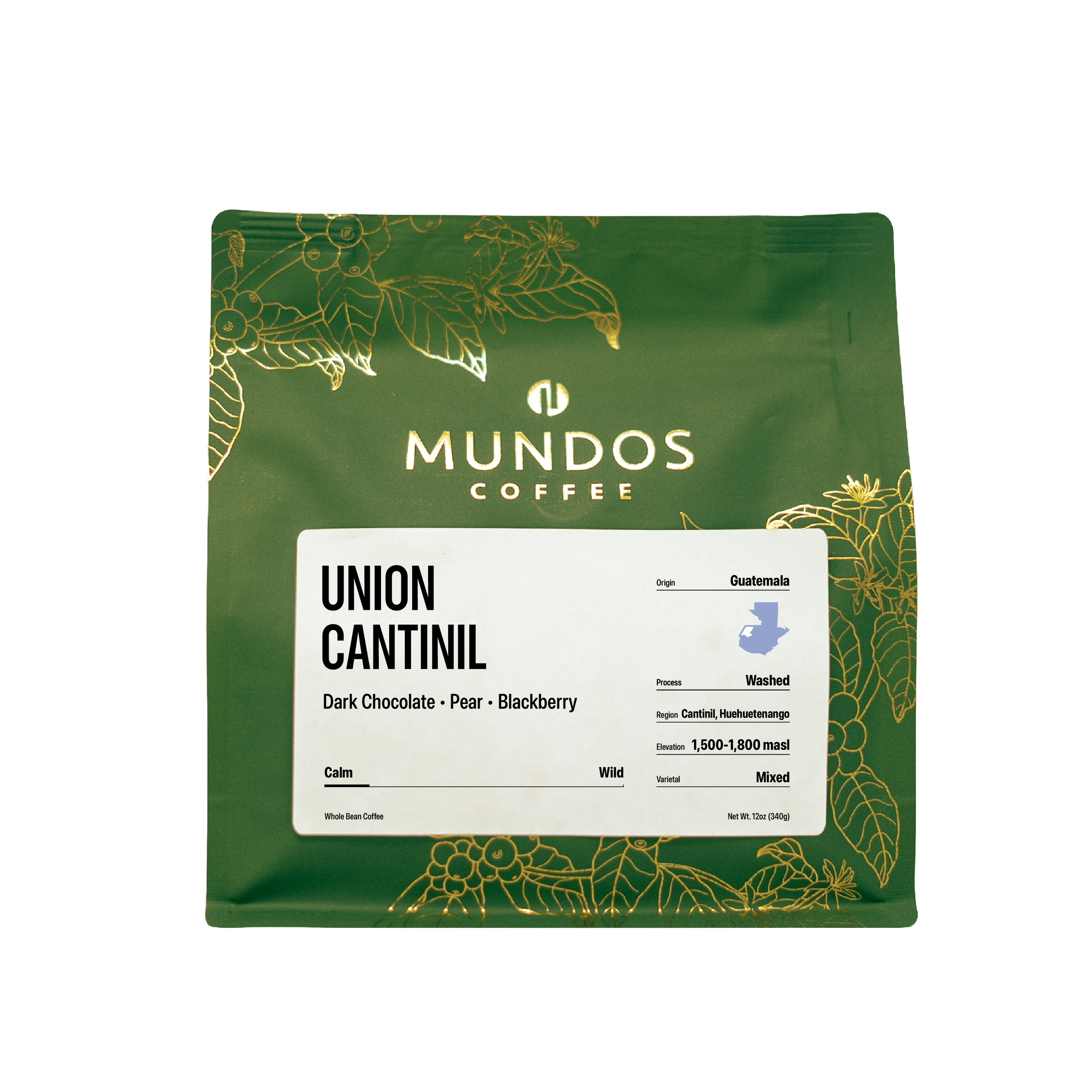
Whole Bean Coffee
[GWAT-AH-MAL-UH • YOON-YIN • KANT-UH-NIL]
Process: Washed
Dark Chocolate, Blackberry, Pear
The return of the nostalgic Guatemala Union Cantinil. This coffee is incredibly cozy with notes of dark chocolate and blackberry, super smooth and sweet.
This is an SHB EP grade washed coffee from Unión Cantinil municipality, located in the Huehuetenango department of Guatemala. This coffee is produced by smallholder farmers who typically have around 1ha of land and cultivate the varieties of Caturra, Catuai, Bourbon & Pache.
The coffee is fully processed by smallholder farmers. Cherries are harvested ripe and then de-pulped usually by either manual or small-motored pulpers. This is then left to ferment overnight until the coffee’s remaining mucilage has broken down. Washing is then carried out, usually in specialised channels.
The washed parchment is always sun dried as the small holders don’t have access to mechanical driers. The drying takes advantage of every bit of flat, full sun space that can be found, which is limited in Huehuetenango due to the mountainous and shaded terroir. This means the coffee is dried on roof tops, small patios and on tarps. It must be turned to ensure even drying and avoid over-fermentation or mold. Once the drying is complete the coffee is delivered to our Union Cantinil buying station for quality control and consolidation.
Huehuetenango is both a large department (or state) and the eponymous capital city of that same department. While coffee isn’t grown in the city of Huehuetenango, it is abundant in the high altitude mountains to the west and north of the city. Producers are predominantly smallholders with around 1 hectare of land. In order to buy coffee directly from these smallholder groups we have installed a number or regional micro-warehouses and buying stations. This has both enabled us to receive coffee directly from the small holders and cut the transport & logistics costs for them; all while providing stable market access for these remote communities.
Our micro-warehouse in Unión Cantinil is located in the heart of the municipality and receives coffee from a small radius of about 15km. This high altitude region has some of the best coffees in Huehuetenango. The generally north facing aspect of the mountains means the sun takes its time reaching the small plots where the coffee is grown. While there is some Catimor planted in the region, the common varietals are more traditional and conducive to a high quality cup, such as Bourbons, Caturras and Pache

12 oz bag of whole bean coffee
Process: Washed
orange marmalade, guava, caramel
Orange marmalade and guava is the best way to describe our new Kenya Karatina. This coffee is bright yet balanced with a warm caramel finish.
Karatina is located in Barichu locale, Mathira division near Karatina town in the Nyeri County, the southern part of the famous Mt. Kenya and part of the Barichu Cooperative Society with about 1,450 small scale farmers. The cherries are fully washed with fresh river water from Ragati River and sundried on raised beds.

12 oz bag of whole bean coffee
Process: Washed
apricot, black cherry, sweet and sour candy
This fully washed AB-grade coffee was grown by the small holder producers in the Mara, Tarime region of Tanzania at 1,750 meters above sea level. Located in Tanzania’s northern highlands above the shores of Lake Victoria, the farmers often grow coffee on less than 2 hectares of land alongside other cash and subsistence crops. Traditionally a region for natural processed coffees, the ideal growing conditions have attracted wet mill operators in recent years so smallholders can sell their coffee as cherry. Not only does this allow farmers to bring coffee to market quicker, it frees up land that would have been devoted to drying.

12 oz bag of whole bean coffee
Process: Washed
apple, cinnamon, cocoa
This lot features selections from Bajo Kimariato, outside the city of Quillabamba in the Cusco region, coming from two smallholder farms: Fortunato Alamanacin's San Rafael and Exaltacion Fuentes's Balconniyoc.
Peru is made up of a wide variety of landscapes, from long beaches to high mountains, from the desert to the largest rain forest. In the north, the second highest mountain rage, the Andes, goes through Cajamarca department and converges with the Amazon, creating complex and diverse orographies and microclimates. Cajamarca’s inter-Andean valleys have hosted coffee crops for more than 200 years and concentrate almost 43% of the total Peruvian coffee production, not only because of its vast lands but because of an ancient coffee tradition that goes back to the XVIII century, when the first coffee crops were brought in and started to be nurtured by the many generations of producers in the region. Coffee has been part of their lives for so long that their inhabitants’ experiences and learnings are inextricably linked to it.

12 oz bag of whole bean coffee
Process: Washed
molasses, red apple, grape
The Nariño region sits on the coast of southern Colombia, just north of the border with Ecuador, where coffee grows in the shadow of the volcano Galeros. Although Galeros is an active volcano, that activity has mostly been ash and steam eruptions in recent times, contributing to the “youth” of the nutrient-rich soil. The region is beautiful but rugged and all the coffee farms are very small above 1,700 meters. This coffee comes from the smallholder members of the “Association of Coffee Producers Ecoterra.” Ecoterra is an organization with 117 producers from the municipalities of La Unión, San Pedro de Cartago, Arboleda and SanLorenzo. Their objective is to work with greater intensity in diversifying the different processes of production and processing of coffee.
There are many different methods of coffee processing and fermentation. These are the most common, but we’re always testing the uncommon in order to keep bringing you new and exciting coffees.