


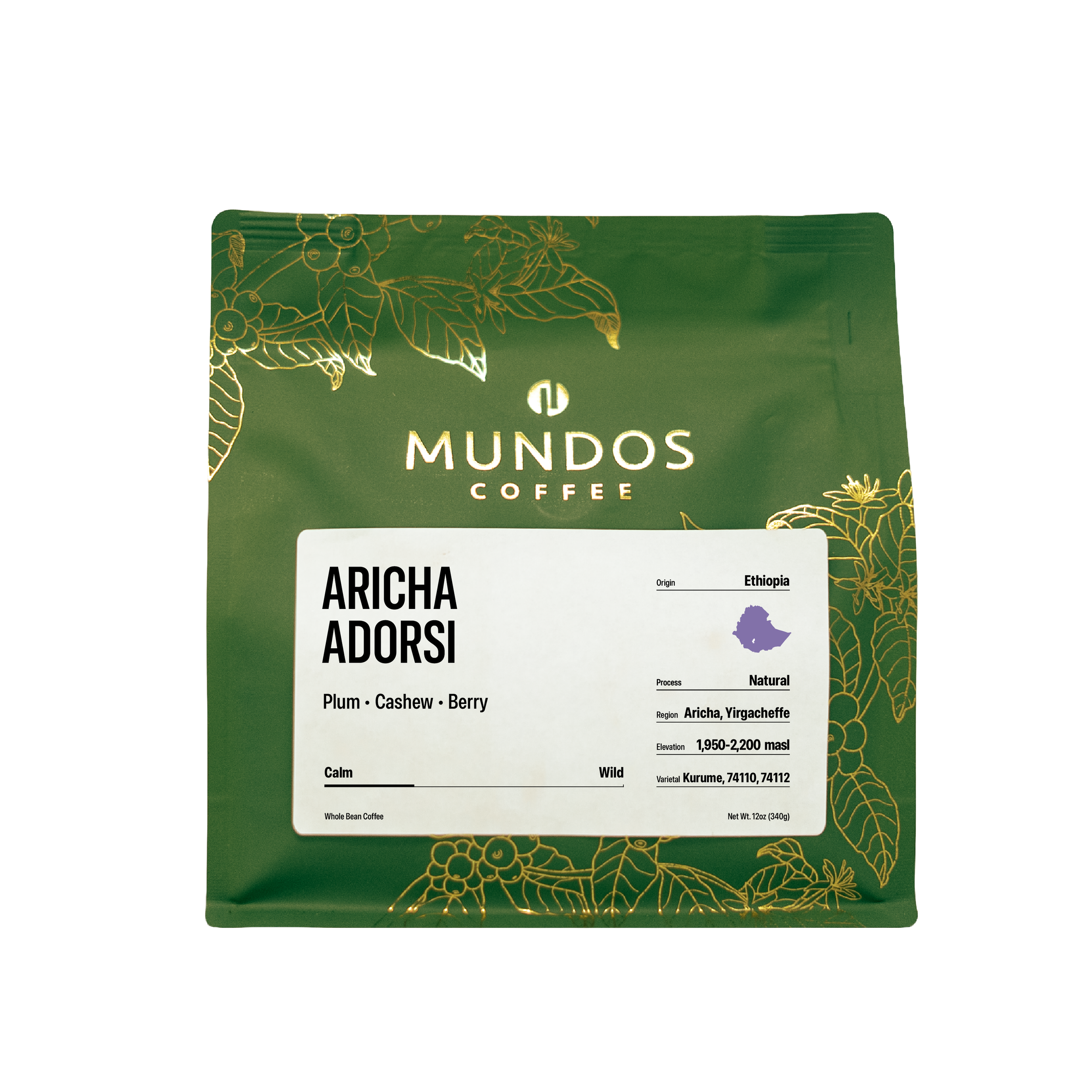
Whole Bean Coffee
[EETH-EE-OPE-YA • AH-REE-CHUH • AH-DOOR-SEE]
Process: Natural
Plum, Cashew, Berry
Classic syrupy natural Ethiopian with refreshing nuttiness, and notes of berry and plum.
From the village of Aricha, located in Yirgacheffe, Adorsi Washing Station is operated by Testi Specialty Coffee. This producer works with local farmers from communities located around their network of washing stations, providing access to education for children of farmers. A Grade 3 and "improved" natural-processed lot, cherries are hand picked and sorted for ripeness, floated for low-density seed removal, and under parabolic shading, laid on unraised beds to dry.
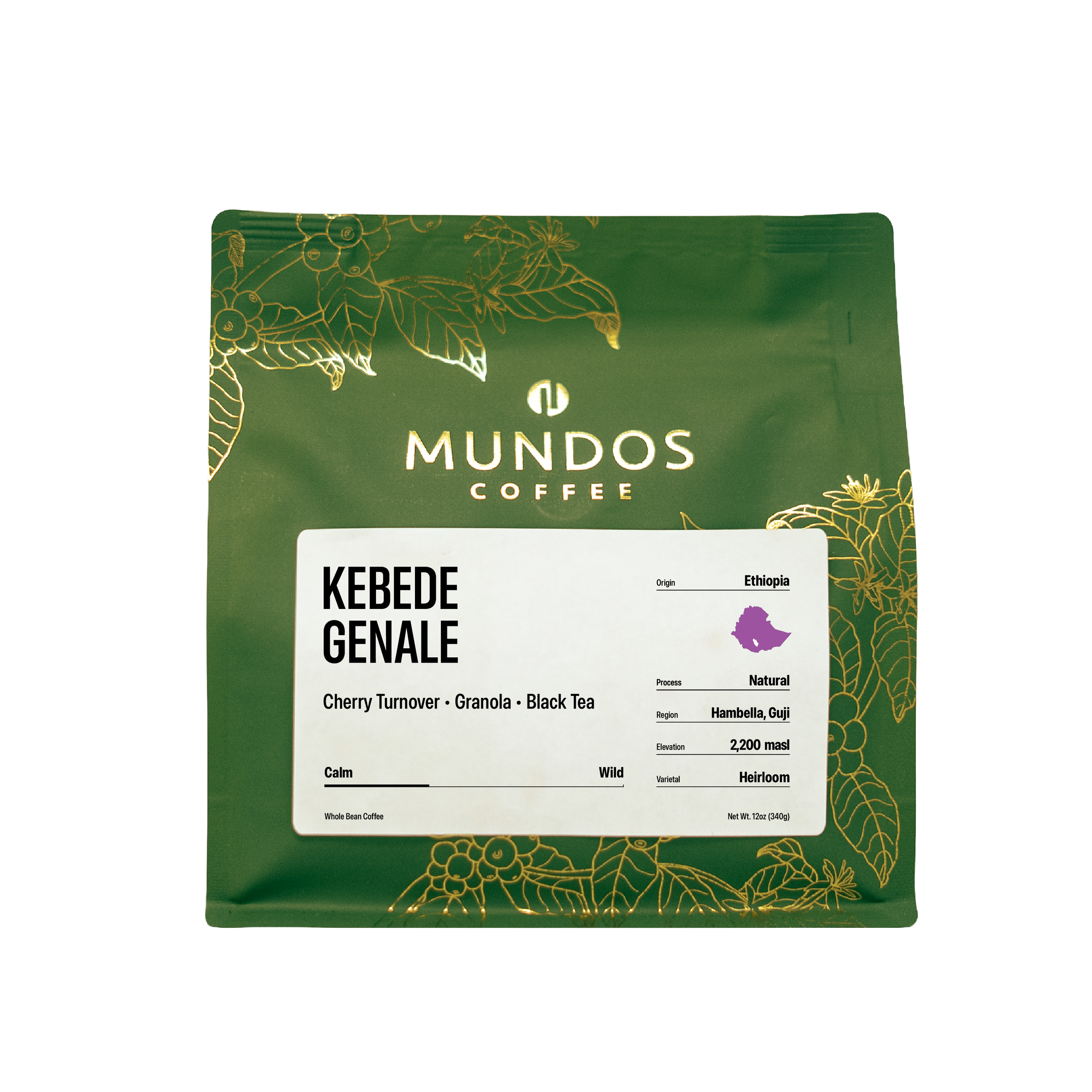
Whole Bean Coffee
[EETH-EE-OPE-YA • KIH-BEH-DEH • GUH-NAH-LEH]
Process: Natural
Cherry Turnover, Granola, Black Tea
Much like the sweet pastry, this natural process coffee has that tartness of a cherry filling complemented by a sugary sweetness, and the body of black tea.
Thirty-one years ago, a 46-year-old farmer walked more than a day on foot from his village to Yirgacheffe for a Bible study trip and came home with coffee seedlings tucked under his arm. At the time, everyone in Buku said the land was too cold for coffee. Kebede Genale planted them anyway.
His first attempt failed. So did the next. But he kept going, learning everything he could from his church community in Yirgacheffe, quietly experimenting in his garden while the rest of the region looked on. Eventually, something remarkable happened: the seedlings took. Mr. Genale became the first farmer in the entire Buku region and possibly all of Hambella to successfully grow coffee at altitude.
Now 77, he still walks his land with an energy that puts most people half his age to shame. His farm spans over 20 hectares, perched at 2,200 meters where mornings arrive cold and frost isn't uncommon. Those long, chilly nights slow the drying process to 16 days or more, and that patience is exactly what makes his coffee so special. The cherries have time to deepen, to sweeten, to become something worth waiting for.
What ends up in your cup is vivid and generous: ripe berries, a ribbon of dark chocolate, and the kind of clarity that only comes from truly high-altitude fruit. Mr. Genale has competed in the Cup of Excellence and reached the top 40. We think that's just the beginning of the recognition he deserves.
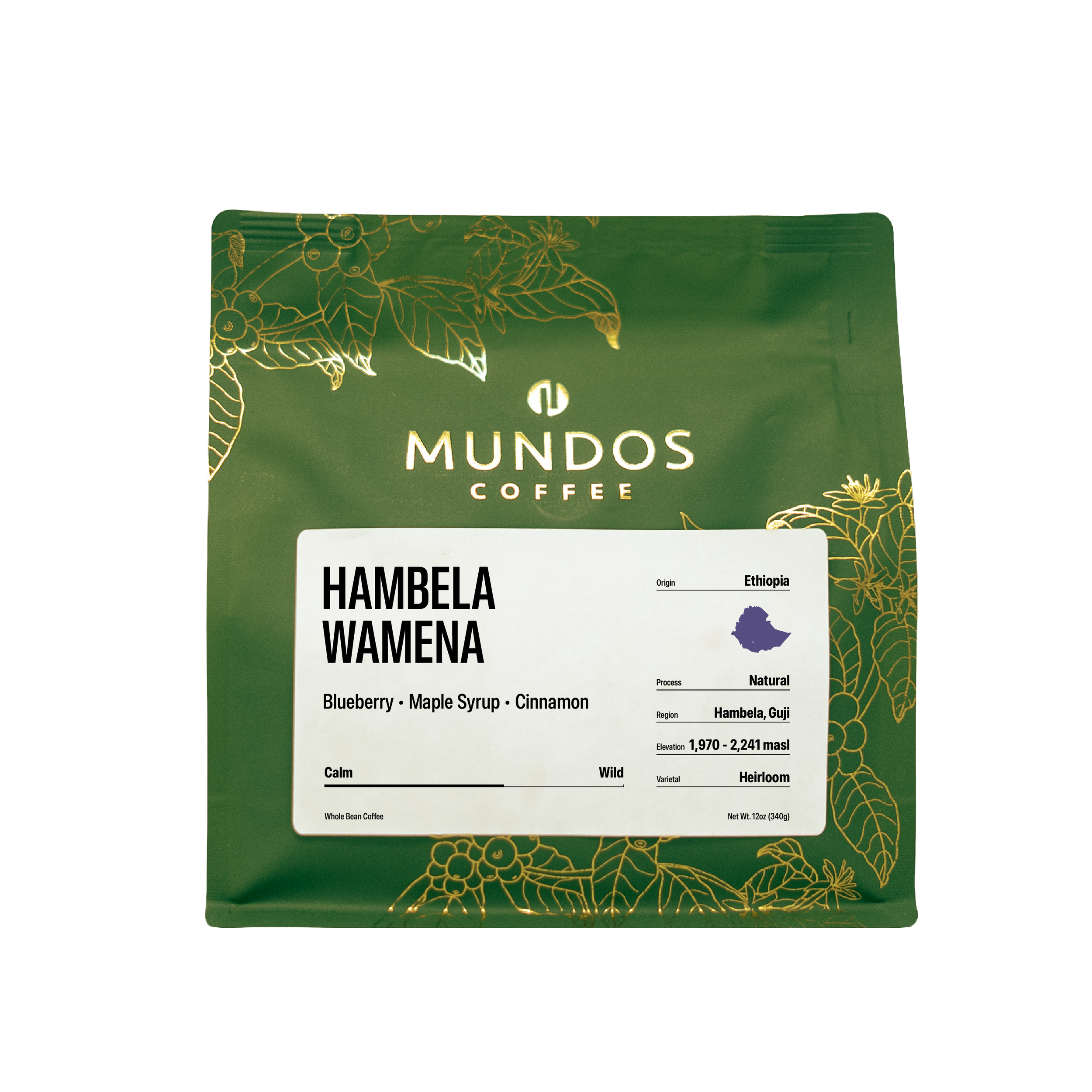
Whole Bean Coffee
[EETH-EE-OPE-YA • HAM-BELL-UH • WUH-MEN-UH]
Process: Natural
Blueberry, Maple Syrup, Cinnamon
Rich and syrupy sweet naturally processed Ethiopia. Notes of cinnamon and blueberry.
The Hambela Wamena Washing Station was founded in 2018 by the founder of Tega & Tula farms. Its location at the top of the highest mountain peak of Guji, Hambela, makes it a central point to serve surrounding towns, and it currently serves around 3,900 producers. There are a number of social programs supported by this washing station, including the building of roads, schools, and technical equipment and support for producers as well as medical health expenses and support for women's health care. Coffees in Ethiopia are typically grown on very small plots of land by farmers who also grow other crops. The majority of smallholders will deliver their coffee in cherry to a nearby washing station or central processing unit, where their coffee will be sorted, weighed, and paid for or given a receipt. Coffee is then processed by the washing station and dried on raised beds. The washing stations serve as many as several hundred to sometimes a thousand or more producers, who deliver cherry throughout the harvest season.
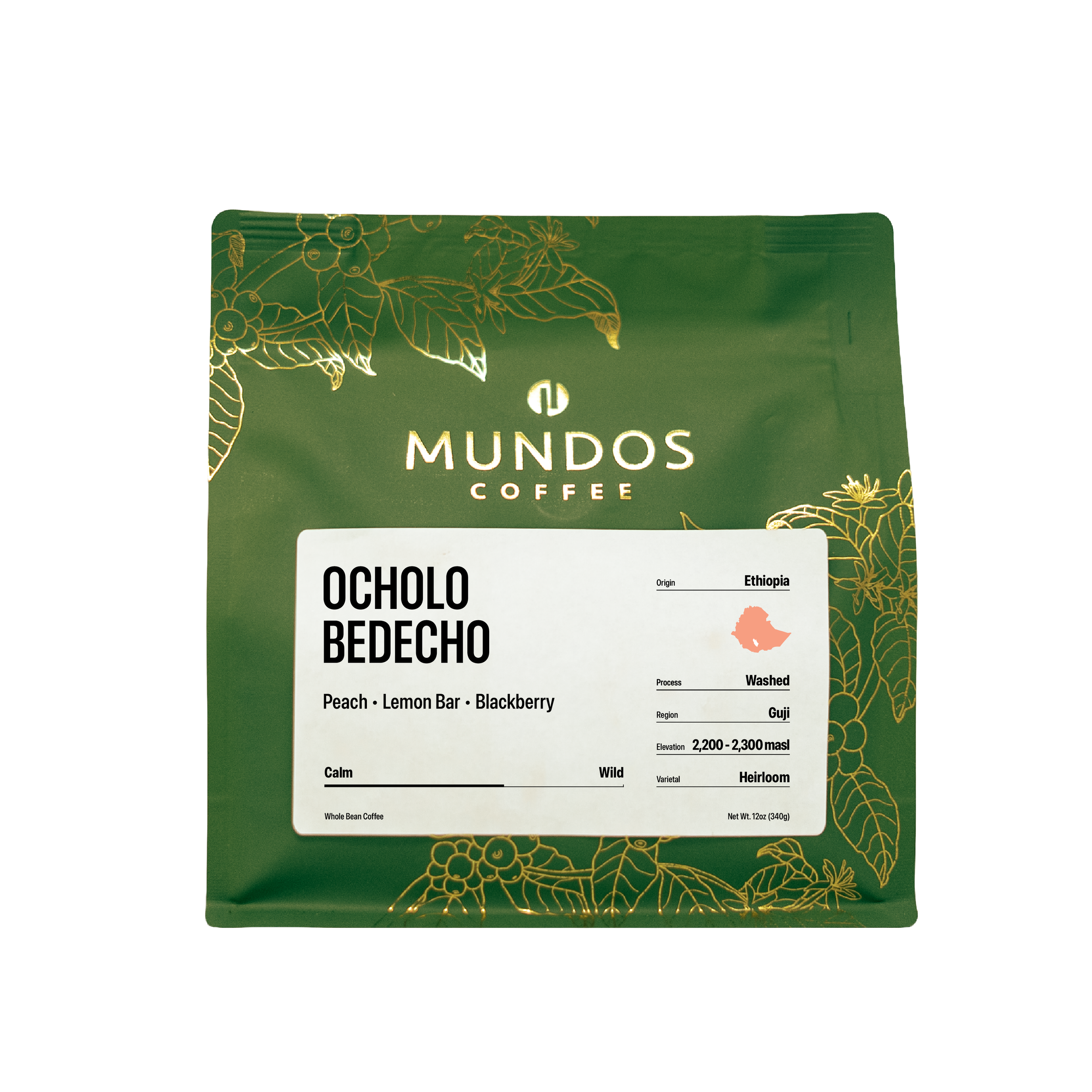
Whole Bean Coffee
[EETH-EE-OPE-YA • OH-CHO-LO • BEH-DEH-CHO]
Process: Washed
Peach, Lemon Bar, Blackberry
Beautifully peachy and tart washed process coffee from Mr. Ocholo Bedecho in Haro Wachu.
Mr. Ocholo Bedecho owns 8 hectares of coffee land in Oromia Regional State, Guji Zone, Urga district. His farm is located 12 km from a small town called Haro Wachu. Most of his income comes from his coffee farm, although he also processes some vegetables and Enset (false banana) for daily food from his backyard/garden. He owns 8 hectares of land. His land size is one of the largest in the district by the standards of the area he lives in. Mr. Ocholo is the father of two daughters and 6 sons, and the family works on the farm full time. Through coffee, he has managed to send all his children to school, although they help in the farm after school when they can.
Whole Bean Coffee
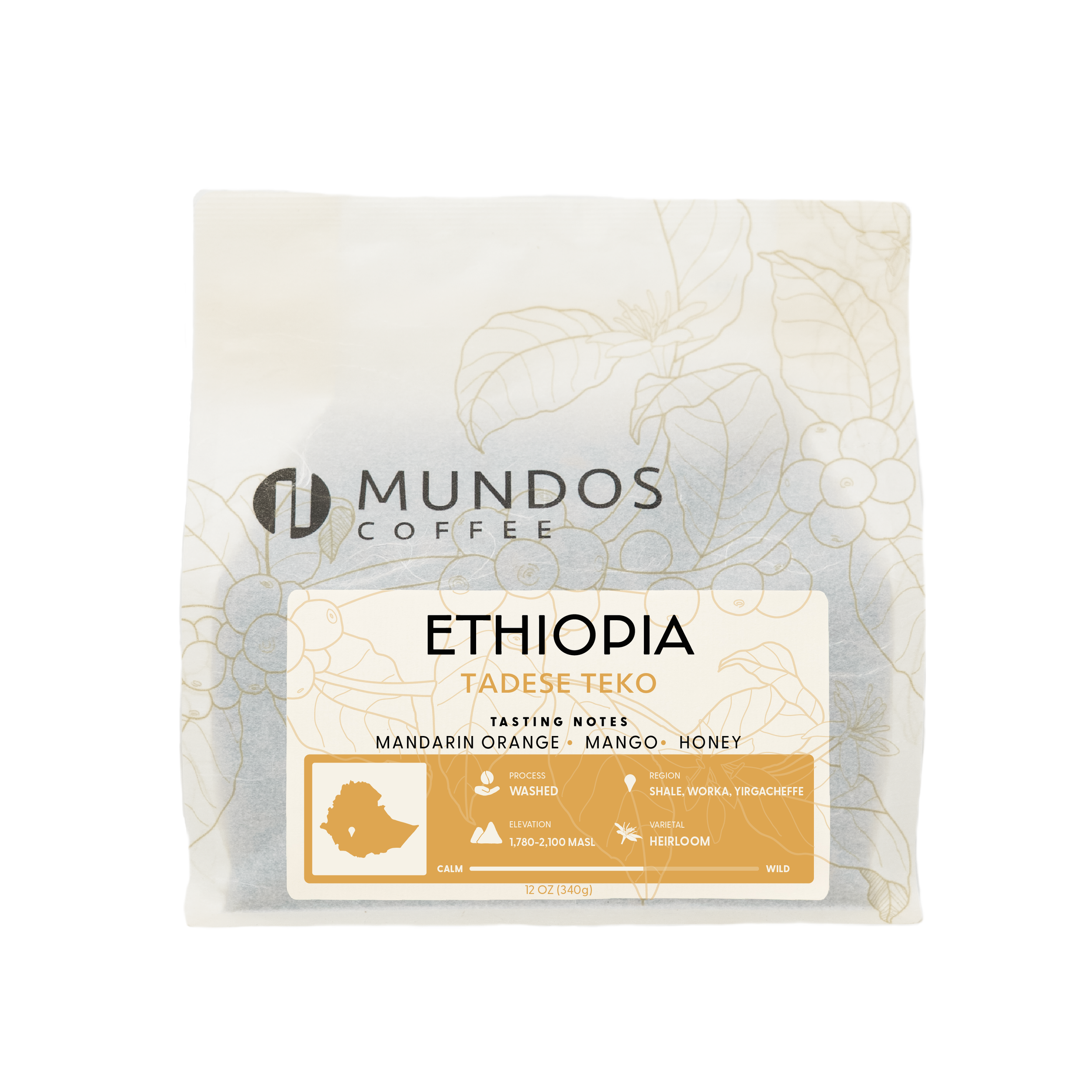
[EETH-EE-OPE-YA • TEY-DEH-SEH • TEY-KO]
Process: Washed
Mandarin Orange, Mango, Honey
Vibrant and aromatic with a syrupy mouthfeel. Sweet notes of mandarin orange, mango, and honey make this an unforgettable cup.
This single producer lot comes from Mr. Tadese Teko in the Shale village near Worka town in Yirgacheffe. Mr Tadese Teko is one of millions of farmers who live in the highlands of Ethiopia and relied on coffee to support their livelihoods. He owns 8 hectares of land which is large by the standards of the area where average land size is 4 hectares. Mr Tadese has 9 children and he manages to send his children to school thanks to the income he receives from coffee sales. Farmers in the area usually create natural fertilizer utilizing waste and no chemical fertilizer is applied for coffee grown in such areas. Besides supplying their coffee most small-holder farmers in the area also work in the washing stations as laborers to get extra income during the picking season. Mr Tadese usually produces washed coffees and usually supplied to to nearby washing stations

HIGHLAND COLLECTION
Whole Bean Coffee
[EETH-EE-OPE-YA • DOO-WAHN-CHO]
Process: Honey
Tropical Fruit, Floral, Watermelon
This vibrant cup has a candy-like sweetness, layered with notes of tropical fruit and watermelon, all wrapped in a gentle, warm florality.
This lot comes to us from the Duwancho washing station in Sidama. The coffee is soaked for two hours here before being placed on raised beds. During drying, the thickness of the cherries is kept as thin as possible to ensure consistency.
The Sidama region is known for producing the most coffee at the highest grades in Ethiopia, and the geography explains why this is. This region spreads across fertile highlands, where half of the land is cultivated. The surrounding rivers and lakes along with the very high elevation results in cool weather and fertile soil. These factors, in combination with over 100 inches of rainfall per year, cause the coffee to ripen slower than in any other region in Ethiopia. There are over 50 cooperatives and 200 washing stations throughout Sidama.
Whole Bean Coffee
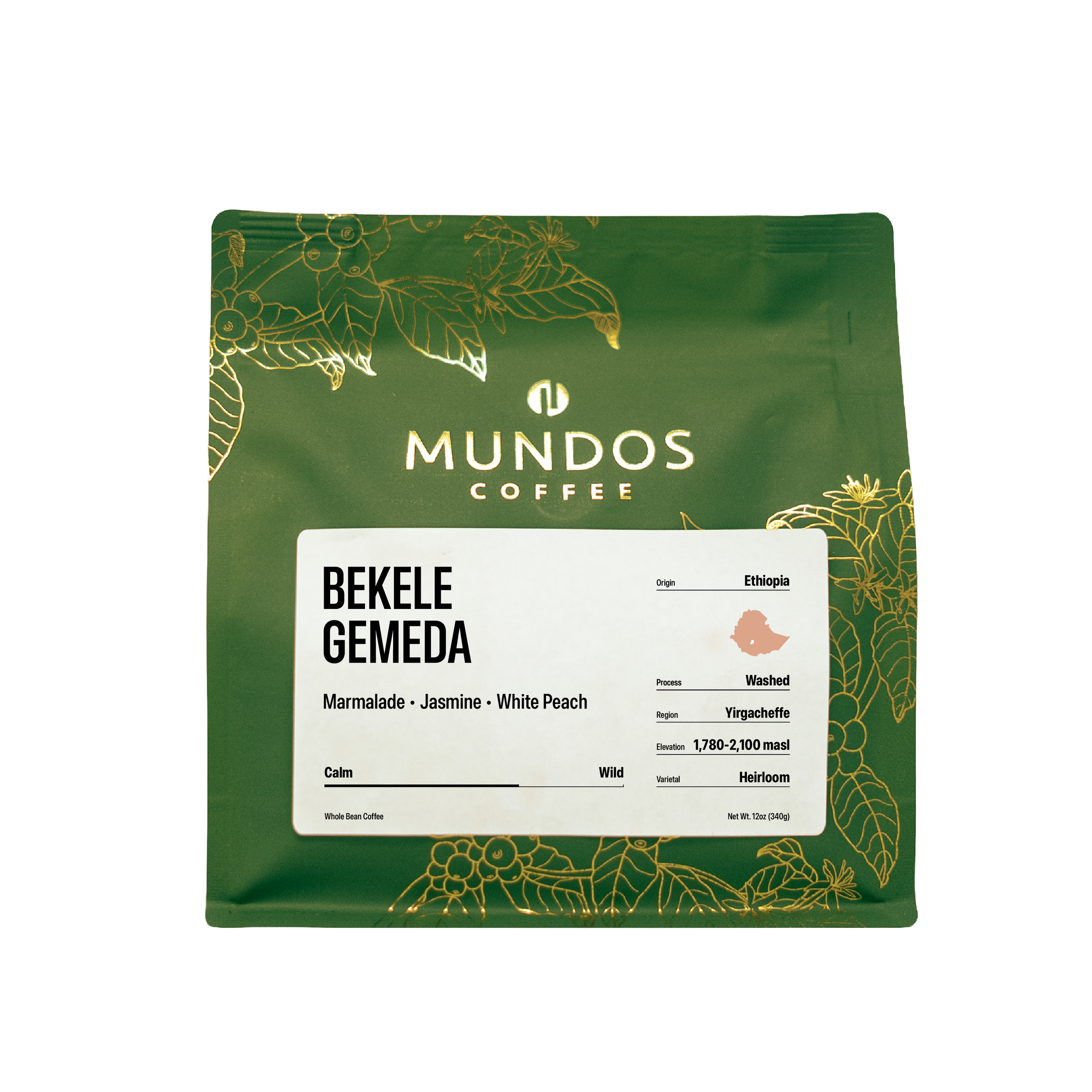
[EETH-EE-OPE-YA • BEH-KEH-LEH • GEH-MEH-DAH]
Process: Washed
Marmalade, Jasmine, White Peach
From Mr. Bekele Gemeda, a resident of the village Worka. He operates the 6.5 hectare farm with his elder sons.
Smooth and vibrant. This washed process coffee has a rich mouthfeel with notes marmalade, jasmine, and white peach.
This single producer lot comes from Mr. Bekele Gemeda in the Worka village in Yirgacheffe. Mr. Bekele Gemeda is a resident of small village called Worka 13 kms from Gedeb town. He owns 6.5 hectares of coffee farm in one place and another 3 hectares in another place within the same village. He works full time in his farm assisted by his able children who completed their primary education but couldn’t find another job in towns. Mr. Bekele, who is the father of 11 children, fully relied on the income he generated from his coffee farm. The coffee farm business also supports his two elder married sons who also work together with him.
Yirgacheffe has become famous for coffees that tastes like blueberries. This region is plentiful. The thick vegetation is a product of the warm tropical climate with moderate wet and dry seasons. Most coffee is shade-grown by small producers using organic practices. Coffees are cultivated from 1600 to 2400 masl in these highlands. The multitude of microregions creates complex profiles depending on the washing station a particular coffee is from.

Whole Bean Coffee
[EETH-EE-OPE-YA • MISS-ISS • GEM-A-DECH]
Process: Natural
Cherry, Plum, Lavender
This natural process Ethiopia is a juicy sweet coffee with plum notes and a beautifully smooth finish that leaves a hint of lavender on your tongue.
Mrs. Gemedech Fulasa was born not too far from where she currently lives, and she is the only child to her parents. She inherited her 4.5 hectare coffee farm when her father passed away in 2011. In the Gedeo culture, land inheritance usually goes to the male children. However, her being the only child, she has taken this opportunity to inherit the land and shine as one of few female coffee farmers and one of the highest quality coffee farmers in Yirgacheffe. Before inheriting the coffee farm, she and her husband supported their family of four children through the Kocho trade. Kocho is a local staple source of carbohydrates that is made from a trunk of a false banana tree, called Enset – a crop that now allows both additional income and improved soil moisture.
Mrs Gemedech’s land in the famed Idedo region of Yirghacheffe (part of Ethiopia’s southern coffee growing region) is a garden farm where coffee is grown under a shade mixed with other fruits and food staples in a regenerative manner. Fallen leaves and coffee pulp hauled from local mills are the main source of compost. Enset trees (false Banana) across the farm collect water from the rainy season inside their trunks and release it to the ground during the dry season. This helps the soils retain moisture all year round.
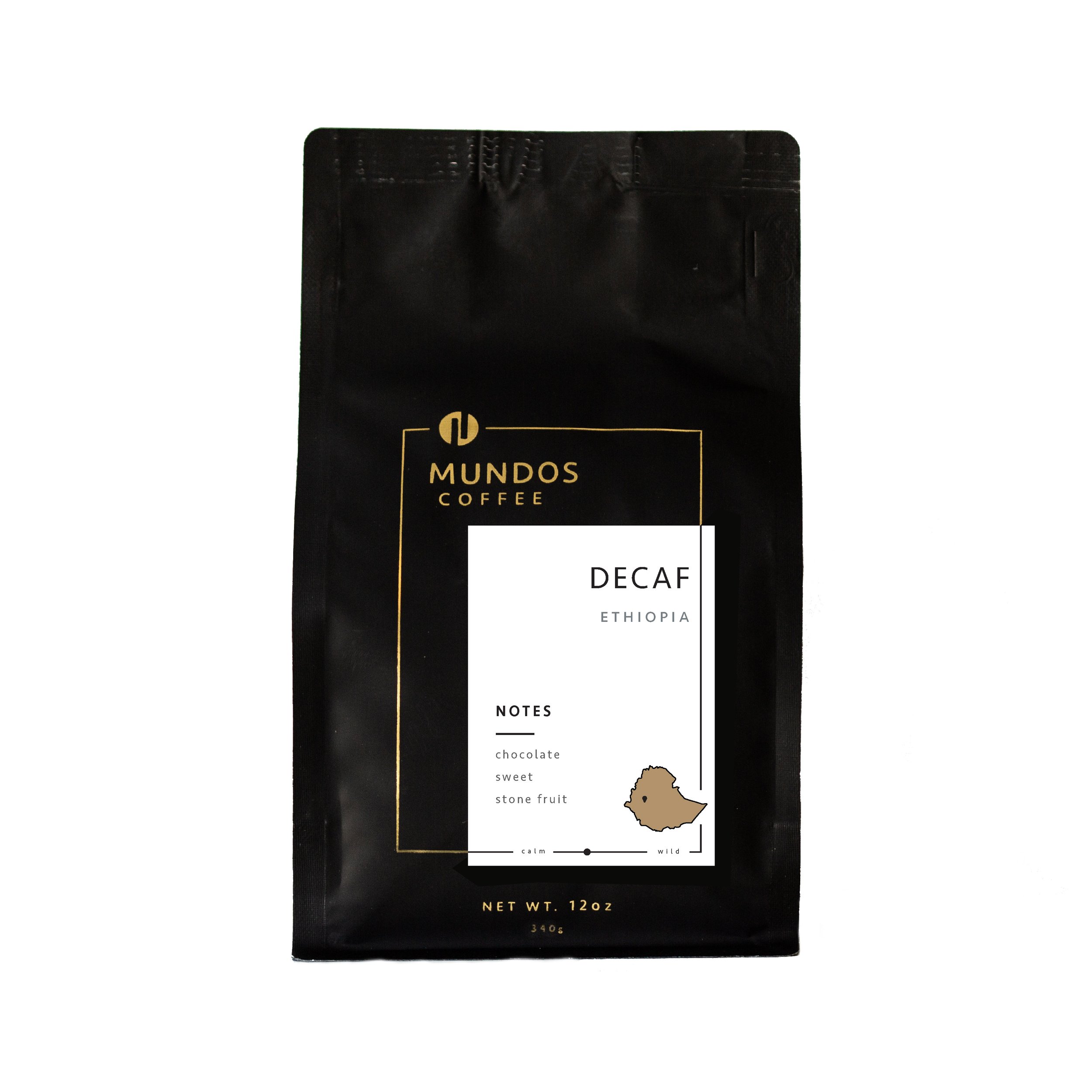
12 oz bag of whole bean coffee
Chocolate, Sweet, Stone Fruit
Kossa Geshe is located in Western Ethiopia’s Limmu Kossa District, in the highlands of the Kebena Forest. This 1,000 hectare farm was established in 2009 as a land grant from Ethiopia’s investment agency to safeguard some of the last remaining dense forest in the country. Abdul runs the show. His first harvest was 2016. The story of Kossa Geshe is one of meteoric rise. In 2016 he began running the farm and two years later his coffee won a Good Food Award – one of the first coffees out of the west to earn the distinction and to truly compete with the excellent naturals coming from Southern Ethiopias Sidamo and Yirgacheffe regions. Abdul continues to reinvest. From a new moisture meter, to a new 7500 m sq drying patio (to go with raised beds) completed in 2018. It goes without saying that quality is continually on his mind.
Whole Bean Coffee
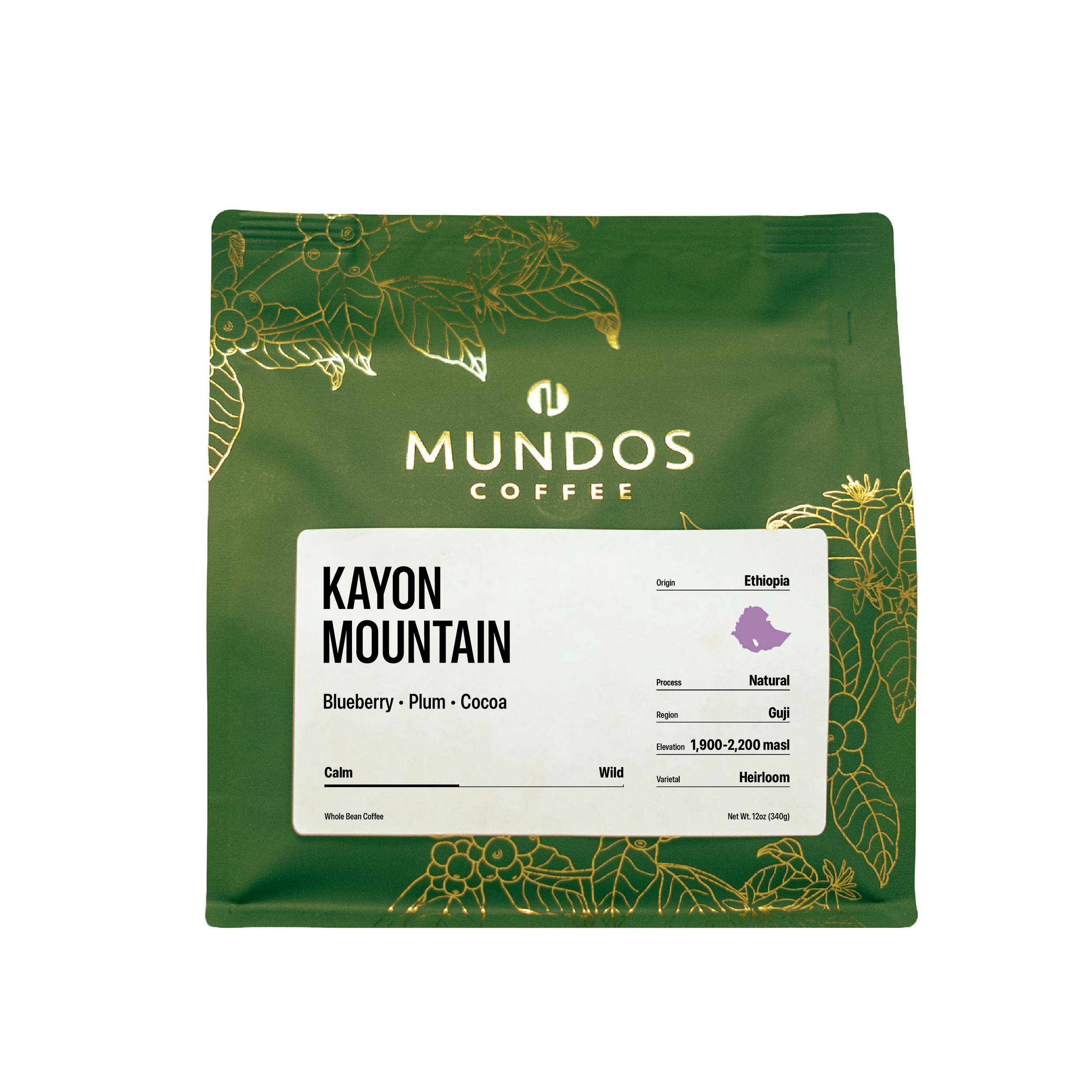
[EETH-EE-OPE-YA • KYE-ON • MOWN-TAN]
Process: Natural
Blueberry, Plum, Cocoa
Syrupy sweet natural process from Kayon Mountain Farm, a beloved coffee from Guji, Ethiopia.
This is a Grade 1, Organic Certified Arabica coffee from The Kayon Mountain Coffee Farm in the Guji zone of Ethiopia's Oromia Region. Established in 2012, the farm began with the aim of producing high quality coffee in a socially and environmentally responsible manner; it is privately owned by Ato Esmael and his family. The farm is a 240 hectare plot in fertile sandy clay loam soil beneath a canopy of natural forest. Coffee is harvested from October to February by members of local villages. Some of it is washed, fermented and dried on raised beds and the rest is left for the production of high quality natural processed coffee. Freshly picked coffee cherries are washed with the low density beans being channeled away for a lower grade. The clean high grade coffees are then placed onto raised beds where for they dry for 12-20 days, before being hand-turned and picked over to ensure perfection.

12 oz bag of whole bean coffee
Process: Washed
kiwi, silky, honeydew
This Grade 1, wet processed coffee is from the Adado Washing Station in the highlands of southern Ethiopia, the coffee region famously known as Yirgacheffe. The farmers who deliver to this washing station are smallholders growing coffee on just a few hectares or as a garden crop above 1800 meters. The coffee plants are Ethiopians heirloom varietals. During milling the coffee is fermented for 24-36 hours depending on weather, washed and then dried on raised beds for one week while final quality sorts are conducted.

12 oz bag of whole bean coffee
Process: Washed
smoked sugar, tangerine, banana
This Grade 1, wet processed coffee is from the Washing Station at Halo Hartume Village in the Gedeb Woreda Zone in the highlands of southern Ethiopia, the coffee region famously known as Yirgacheffe. The nearly 800 farmers who deliver to this washing station are smallholders growing on 1 to 10 hectares above 1900 meters. The coffee plants are Ethiopians heirloom varietals like Dega and Wolisho. During milling the coffee is fermented for 24-36 hours depending on weather, washed and then dried on raised beds for one week while final quality sorts are conducted.
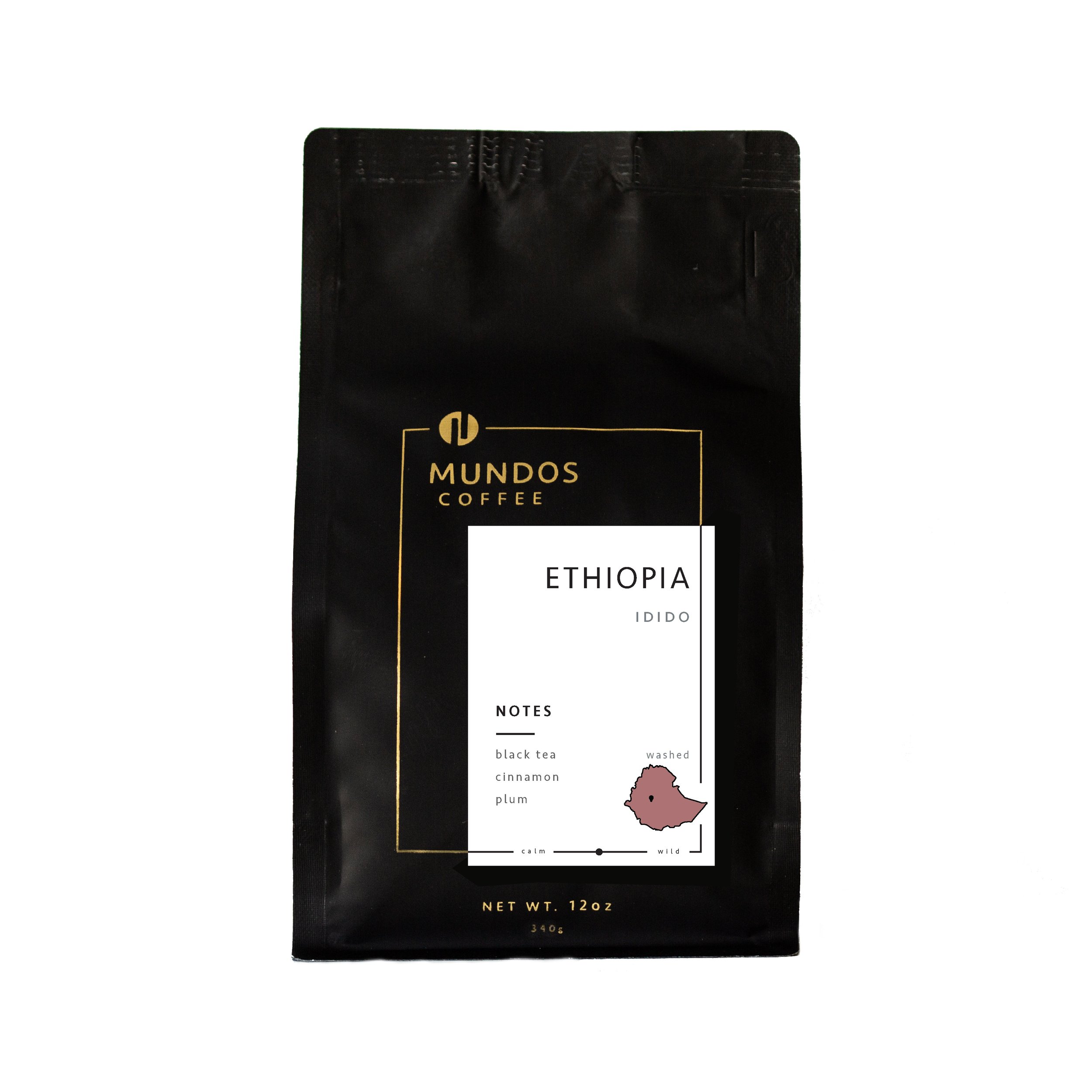
12 oz bag of whole bean coffee
Process: Washed
black tea, cinnamon, plum
Yirgacheffe is part of the Gedeo Zone, Southern Nations Nationality and people's region (SNNP), in southern Ethiopia. The exquisite washed coffees are so well known that is has been subdivided into its own micro-region. This steep, green area is both fertile and high - much of the coffee grows at 2,000 meters and above. At first glance, Yirgacheffe's hills look thickly forested. But it actually is a heavily populated region, and the hills are dotted with many dwellings and villages' growing what is known as 'garden coffee.' This is when families grow coffee on small plots of land surrounding their homes. There are approximately 26 cooperatives in the region, representing some 43,794 farmers and around 62,004 hectares of garden coffee. The production is predominantly washed, although a smaller number of natural sundried coffees also come out of Yirgacheffe.

Whole Bean Coffee
[EETH-EE-OPE-YA • LAY-OH • TAH-RA-GUH]
Process: Washed
Peach Rings, Marshmallow, Cinnamon
Juicy sweet coffee grown at high altitudes in Ethiopia, you'll find notes of sweet cinnamon and marshmallow.
Founded in 1976, the Layo Teraga cooperative provides market access for its smallholder members that would otherwise not have existed in Guji, where prices for coffee have historically been lower than neighboring Gedeo or Sidama zones because of this lack of market access. Located in northern Uraga in the Guji zone, the 1841 smallholder members of the cooperative grow coffee in gardens around their homes in semi-forested environments at staggeringly high elevations of 2342 MASL.

12 oz bag of whole bean coffee
Process: Washed
honeycomb, rhubarb, pear
Nano Challa is a member of the Kata Muduga Union – a group of the leading coffee cooperatives in the West of Ethiopia, mainly centered around Agaro. Nano always cups at or near the top when we’re looking at the the offers from Kata Muduga’s cooperatives each year.

12 oz bag of whole bean coffee
Process: Washed
papaya, nectarine, pineapple
The Nensebo Riripa from Ethiopia has delicious notes of papaya and nectarine and has a tea-like smooth mouthfeel.
This coffee is sourced from smallholders in Riripa village in West Arsi, Sidamo. Farmers cultivate coffee at 1,900 to 2,200 meters above sea level. They deliver their coffee to a local washing station owned and operated by SNAP Trading.

HIGHLAND COLLECTION
Whole Bean Coffee
Process: Anaerobic Natural
Candied Peach, Milk Chocolate, Shortcake
As part of our Highland Collection, this limited release Anaerobic Basha Bekele is an exquisitely juicy and flavorful cup, you'll find notes of candied peach and milk chocolate.
Basha’s father— a community man who with Basha built a church for the community at their site in Bombe—was once a manager for a co-op in Bombe that supplied coffee to the Sidama Union. Before the government made it possible for smallholders to obtain export licenses, both he and his father sold their cherry to the cooperative. Basha now has his own export license and grows coffee (primarily 74158, known locally as “Walega”) in semi-forested plots on 12 hectares in addition to operating collection sites in Bombe, Shantawane, and Kokose—collecting cherry from producers growing coffee as high as 2300 masl. Basha exclusively produces dry processes—which includes experiments with anaerobic styles of fermentation—and practices cherry flotation before drying his coffee slowly on raised beds (with some preparations drying under shade).
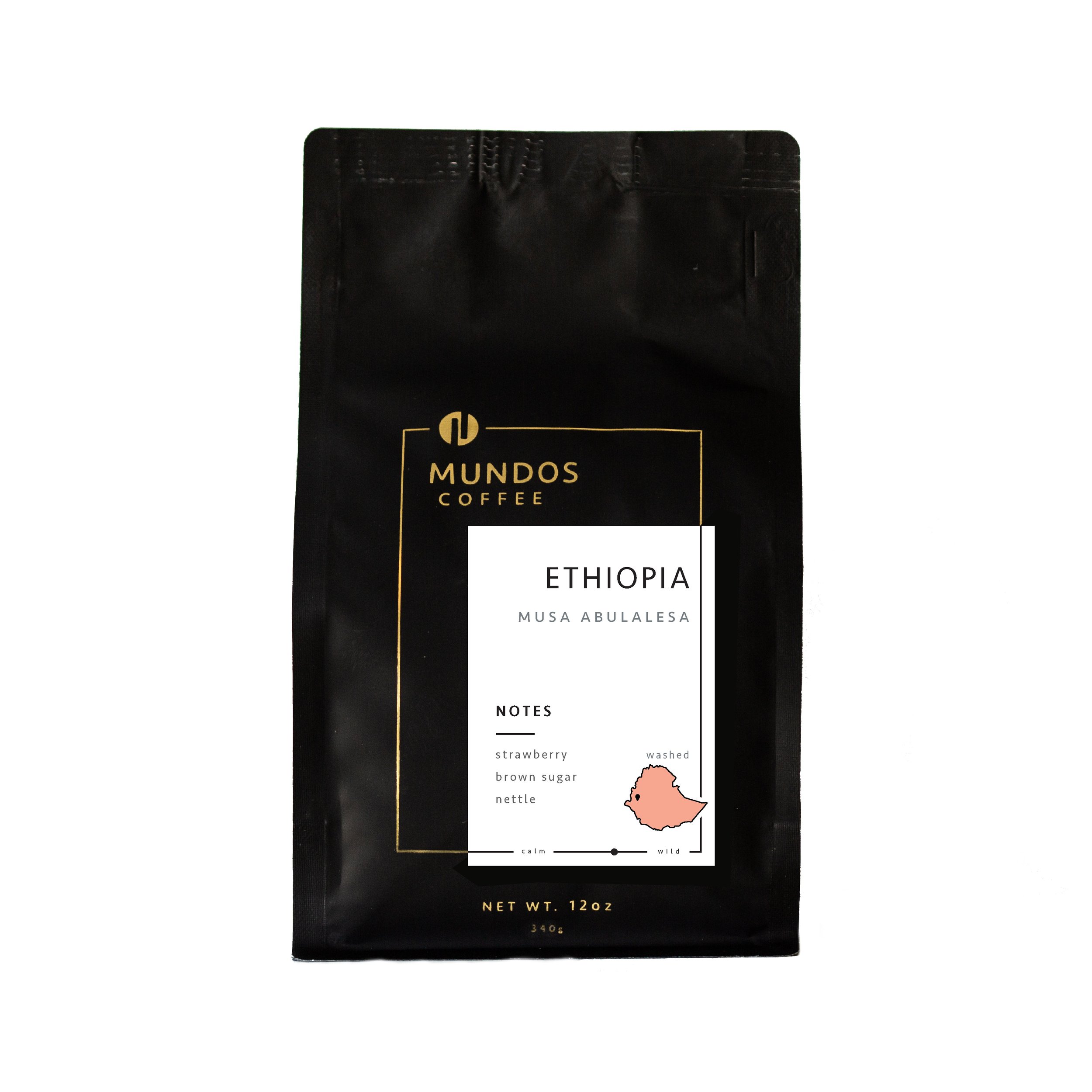
Whole Bean Coffee
Process: Washed
Strawberry, Brown Sugar, Nettle
Washed Musa Abulalesa with notes of Strawberry and Nettle, this Ethiopian is grown at 2,100 meters above sea level balanced out with a brown sugar finish.
Musa Abulelessa and his two brothers, Mustefa and Gugu, all own small farms in the Goma region of Agaro—with Musa and Mustefa operating two farms together outside of Beshasha called Koye and Chanko. Before the undergrowth was cleared for coffee, Musa and Mustefa’s jungle parcel at 2100 meters elevation was a hideout for their father, Abalulessa, guerilla fighting the oppressive military government of the time called The Derg. Failing to capture him and having lost soldiers in their attempts, the government offered the local community a bounty for Abalulessa’s capture. With his health deteriorating and near death, Abalulessa turned to an old friend and, as thanks for nursing him through his final months,told him to tell the government he had killed him, thus benefiting from the bounty. Abalulessa died in 1977—when Musa was just two years old—and as part of a subsequent amnesty and reconciliation program, the government gave land to the brothers and their mother, which Abulelessa’s sons now farm.

Whole Bean Coffee
Process: Natural
Banana, Brown Sugar, Blueberry
Syrupy sweet and juicy Melese Wolde, divulge into this natural Ethiopian with notes of banana and blueberry.
Melese Wolde’s farm in Shantawane developed a reputation for quality after winning a competition through one of the major specialty importers twice—an importer who never, in the end, showed up to buy the coffee. Melese is a farmer through and through, he said, as he stood in his warehouse to avoid the rain, his coffee sleeping protected under plastic tarpaulins on his raised beds. He said would have happily continued to sell his farm’s cherry to private washing stations if the government had not given him the ability to get his own export license—which he did, in 2018. His son, the oldest of his six children, helps him and runs the harvest.

Whole Bean Coffee
[EETH-EE-OPE-YA • KAH-NISS-AH]
Process: Honey
Mandarin, Brown Sugar, Peach
This honey processed Ethiopia is so sweet, with notes of brown sugar and mandarin.
One of the newer cooperatives within the Kata Meduga union, Kenissa was founded in 2018 and processes and markets coffee for its 305-310 members who grow coffee in Agaro.
The details matter, and at Kenissa, they show up in coffee. Most of Kenissa’s members grow variety 74110, with some still having a small amount of 74177.
The young cooperative’s leadership is unusually committed to its success: former members who have secured their own export licenses to market their coffee directly continue to serve on its board or in management roles to help their community, understanding the cooperative’s value for improving the incomes and livelihoods of its members.

Whole Bean Coffee
[EETH-EE-OPE-YA • AH-KAY-SHA • GOO-JEE]
Process: Washed
Brown Sugar, Peach, Silky
As you’ll see in the tasting notes, this Acacia Guji is silky and sweet. Notes of peach and brown sugar.
Named for Ethiopia’s national tree, Acacia Core Coffee comes from smallholder farmers in the Yirgacheffe and Guji regions. The sweet, fruity profile of Ethiopia Acacia Washed is selected to represent the classic flavors of some of Ethiopia’s best recognized coffee producing regions. Ethiopia Acacia Washed is produced by the smallholder farmers who characterize the coffee production landscape of Ethiopia.
In these southern regions of Ethiopia farmers pick coffee selectively, harvesting only ripe cherries individually by hand. Pickers rotate among the trees every eight to ten days, choosing only the cherries which are at peak ripeness. Coffee is depulped and washed by hand in cement canals at community washing stations. After fermenting in water to loosen the mucilage, wooden paddles are used to fully wash the coffee. Coffee is then placed on raised beds to dry in the sun.

HIGHLAND COLLECTION
Whole Bean Coffee
[EETH-EE-OPE-YA • NEY-YA • FA-DEEL]
Process: Washed
White Tea, Peach, Seltzer
A welcome addition to the Highland Collection, this washed process coffee from Neja Fadil is delicate and complex, with notes of white tea and peach.
The Neja Fadil wet mill has registered about 250 farmers who are located in the villages surrounding the wet mill (in Tobitu Tuta Kebele). This lot (from 45 of the 250 registered farmers) is unique, in that - even as part of the coffee powerhouse Guji region - only over the past few years have residents of Tobitu Tuta begun farming coffee. Mr. Neja Fedil is a recent arrival to coffee export, having built his washing station in 2017 after working for several years as a coffee collector on commission for other washing stations. In his youth - also recent! - Neja played on his local district football (soccer) team. As is becoming increasingly common at private washing stations in Ethiopia now, the station is currently expanding registration of farmer suppliers and launching agronomy trainings to expand quality control to the farm level.

Whole Bean Coffee
[EETH-EE-OPE-YA • SA-DA-MO]
Process: Natural
Brownies, Strawberry Pie, Pomegranate
Easy going, rich and sweet natural process from Sidamo, Ethiopia

Whole Bean Coffee
[EETH-EE-OPE-YA • EN-GEESE-AY • NAR-AY]
Process: Natural
Blueberry Jam, Cocoa, Raspberry
Exceedingly sweet natural process coffee from producer Nguisse Nare in Sidamo, Bensa, Ethiopia. Silky mouthfeel with notes of blueberry jam, cocoa, and a raspberry sweetness.
Sitting atop a ridge at 2300 MASL in Bombe, Nguisse Nare’s 10 hectare farm “Setame” is planted with variety 74158 intercropped with taro and sweet potato. With his two other farms—one in Kokose, one in Tiburo—he produces natural and anaerobic coffees using his own cherry as well as cherry collected from around 60 of his neighbors. He floatshis cherry before drying them slowly on raised beds over 20 days.

Whole Bean Coffee
[EETH-EE-OPE-YA • MOOS-AH • A-BOO-LA-LEH-SAH]
Process: Anaerobic Yeast Washed
Orange Marmalade, Sweet Bread, Peach Cobbler
This is a new anaerobic yeast washed process coffee from one of our favorite producers in Ethiopia: Musa Abulalesa. Bright and clean with notes of orange marmalade and sweet bread.
Musa Abulelessa and his two brothers, Mustefa and Gugu, all own small farms in the Goma region of Agaro—with Musa and Mustefa operating two farms together outside of Beshasha called Koye and Chanko. Before the undergrowth was cleared for coffee, Musa and Mustefa’s jungle parcel at 2100 meters elevation was a hideout for their father, Abalulessa, guerilla fighting the oppressive military government of the time called The Derg. Failing to capture him and having lost soldiers in their attempts, the government offered the local community a bounty for Abalulessa’s capture. With his health deteriorating and near death, Abalulessa turned to an old friend and, as thanks for nursing him through his final months,told him to tell the government he had killed him, thus benefiting from the bounty. Abalulessa died in 1977—when Musa was just two years old—and as part of a subsequent amnesty and reconciliation program, the government gave land to the brothers and their mother, which Abulelessa’s sons now farm.

HIGHLAND COLLECTION
Whole Bean Coffee
[EETH-EE-OPE-YA • CHOR-SOH]
Process: Washed - Extended Fermentation
Apricot Jam, Black Tea, Floral, Bergamot
Extended Fermentation maintains a consistent water environment throughout fermentation, and is closely monitored to prevent over-fermentation. This controlled process results in dynamic, sweet coffee that reflects the terroir.
Delicate and complex cup, light body with a bergamot mouthfeel, finishes with the sweetness of apricot jam.
From the Chorso kebele in the Yirgacheffe growing area, smallholder producers combine their harvest of Ethiopian heirloom and landrace varieties to be processed through an Extended Fermentation Washed process. This process at the Chorso washing station begins with ripe cherries, which undergo meticulous sorting and float tank separation to ensure only the highest density fruit is processed. The cherries are pulped to remove skins, then placed in fermentation tanks to loosen mucilage from the beans.
Unlike traditional Washed methods, the purpose of the Extended Fermentation method is to maintain a consistent water environment throughout fermentation, conserving water and is closely monitored to prevent over-fermentation. This controlled process results in dynamic, sweet coffee that reflects the terroir.
After fermentation, the parchment coffee is rinsed in washing channels with filtered river water, agitated until clear, and then drip-dried for 6-10 hours. Finally, the coffee is spread on shaded open-air drying tables to further reduce moisture content.
Whole Bean Coffee
[EETH-EE-OPE-YA • BANK-OH • GO-TEE-TEE]
Process: Washed
Papaya, Strawberry, Plum
Banko Gotiti is a village in the Gedeb district of Ethiopia's Gedeo Zone, where Yirgacheffe is located. The Banko Gotiti cooperative was founded in 2012, separately from the Worka cooperative, which is a larger organization. Banko Gotiti has about 300 members, who grow a mix of heirloom Ethiopian varieties of coffee. Coffees in Ethiopia are typically grown on very small plots of land by farmers who also grow other crops. The majority of smallholders will deliver their coffee in cherry to a nearby washing station or central processing unit, where their coffee will be sorted, weighed, and paid for or given a receipt. Coffee is then processed, by the washing station and dried on raised beds. The washing stations serve as many as several hundred to sometimes a thousand or more producers, who deliver cherry throughout the harvest season: The blending of these cherries into day lots makes it virtually impossible under normal circumstances to know precisely whose coffee winds up in which bags on what day, making traceability to the producer difficult.